 English



Oil Flash Point Tester—Accurate, ASTM D92 & PMCC Ready
Oil Flash Point: what really matters in the lab and on the line
Ask any reliability engineer and they’ll tell you: Oil Flash Point testing sits at the crossroads of safety, compliance, and good old-fashioned product quality. I’ve watched teams debate methods for hours—COC vs. PMCC—because, to be honest, the wrong setup can skew results and trigger unnecessary alarms. That’s why the PUSH Electric PS-KS403T caught my attention.
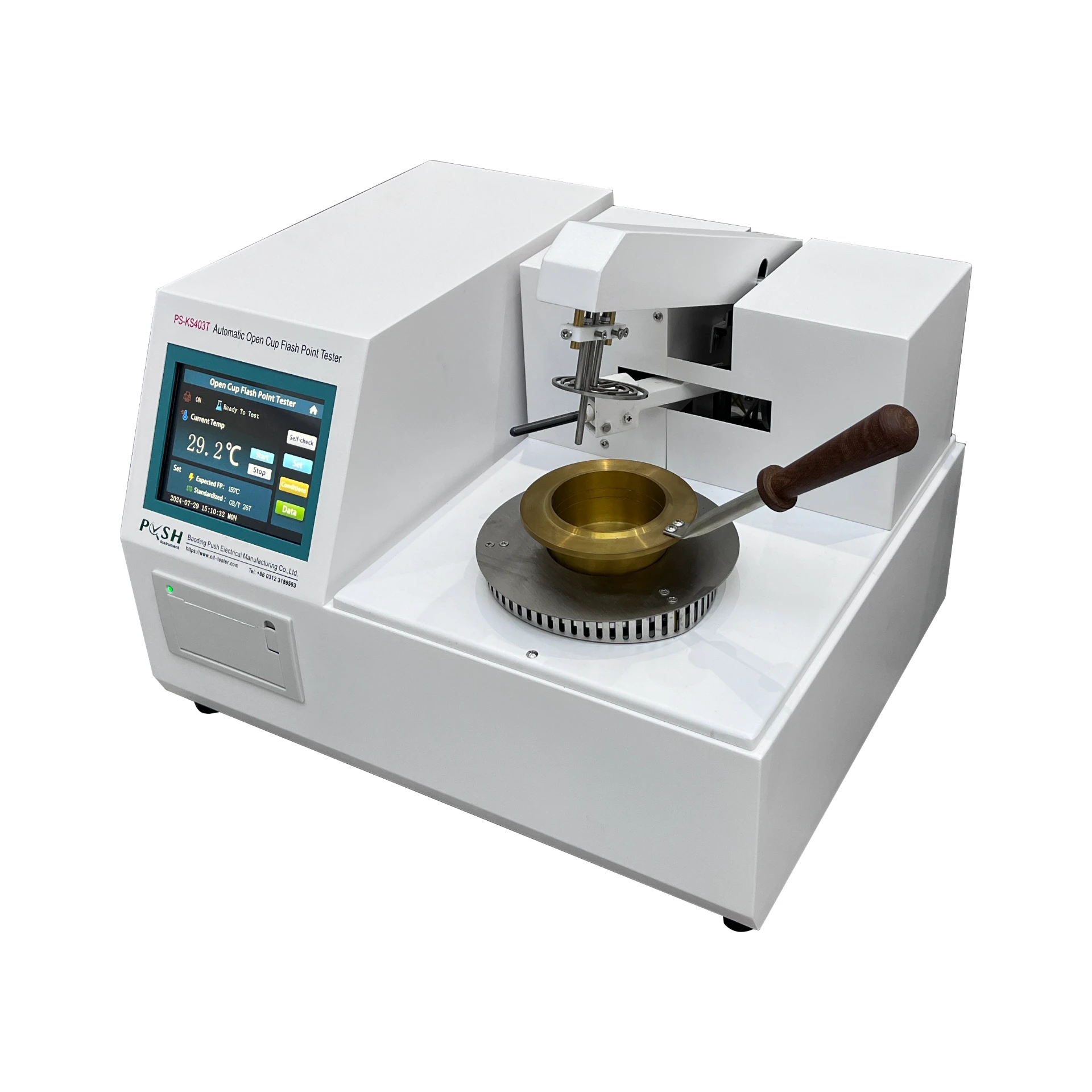
The PS-KS403T is an ASTM D92 Cleveland Open Cup unit with a silicon nitride ignition head (harder to oxidize, lasts longer) and a large touch screen—no clunky typing keyboards, no confusing logo keys. It’s built for railways, aviation, electricity, petroleum, and research labs that need consistent, standards-driven results. And it’s assembled in Baoding, Hebei, at Room 302, Building 5, Baoding Zhongguancun Digital Economy Industrial Park—yes, an actual place, not a P.O. box.
Why labs are switching now
Two trends stand out: tighter safety audits and faster turnaround expectations. Many customers say the touchscreen workflow reduces training time. And the silicon nitride igniter—surprisingly durable—pushes maintenance intervals out by years in normal duty cycles.
Technical specifications (PS-KS403T)
| Method | ASTM D92 Cleveland Open Cup; GB/T 3536; IP 36 |
| Measuring range | ≈ 40–400 °C (real-world use may vary with sample type) |
| Resolution / accuracy | 0.1 °C / ±2 °C typical (per calibration) |
| Ignition system | Silicon nitride ignition head; service life ≈ 3–5 years lab duty |
| Display & control | Large LCD touch screen; guided prompts (no logo-key confusion) |
| Data & I/O | USB/RS-232; print/export; optional LIMS integration |
| Power | AC 220 V, 50/60 Hz |
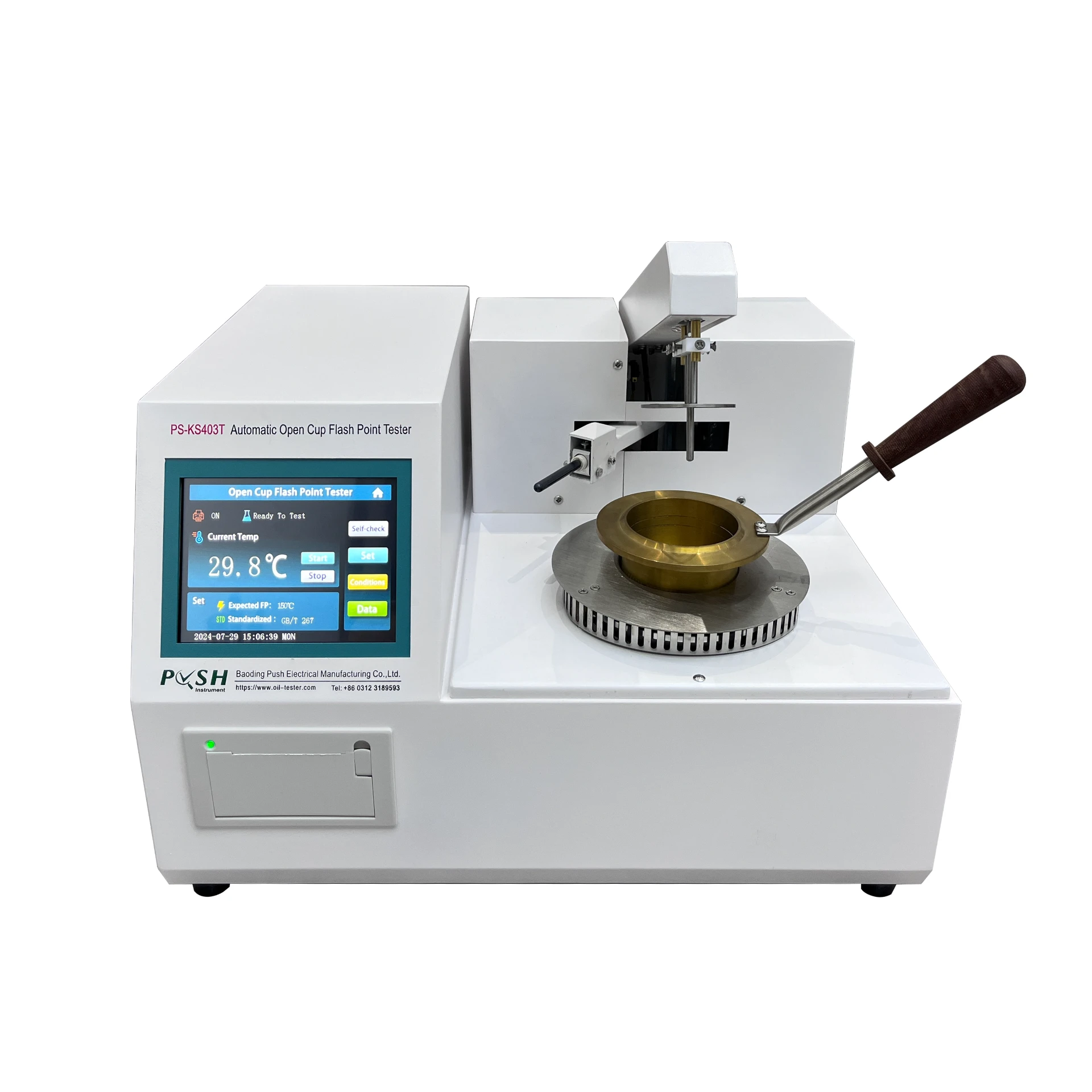
Process flow, methods, and standards
- Materials: brass Cleveland open cup; silicon nitride igniter; certified reference oils.
- Method: heat at 5–6 °C/min; sweep flame passes; detect sustained flash per D92 criteria.
- QA: verify against CRMs; annual calibration to ISO/IEC 17025 lab recommended.
- Service life: igniter typically multi-year; cup maintenance by light polishing.
- Industries: rail depots, airline MRO, power-generation turbine lube labs, refineries, R&D.
Vendor comparison (real-world notes)
| Feature | PUSH PS-KS403T | Vendor B (OC tester) | Vendor C (OC tester) |
|---|---|---|---|
| Standards | ASTM D92, GB/T 3536 | ASTM D92 only | ASTM/ISO selectable |
| Igniter | Silicon nitride (long-life) | Metallic coil | Ceramic |
| UI | Touch; guided prompts | Buttons + small LCD | Touch; advanced menus |
| After-sales | Training + remote support | Basic warranty | Regional partners |
| Lead time | ≈ 2–4 weeks | ≈ 4–6 weeks | Varies |
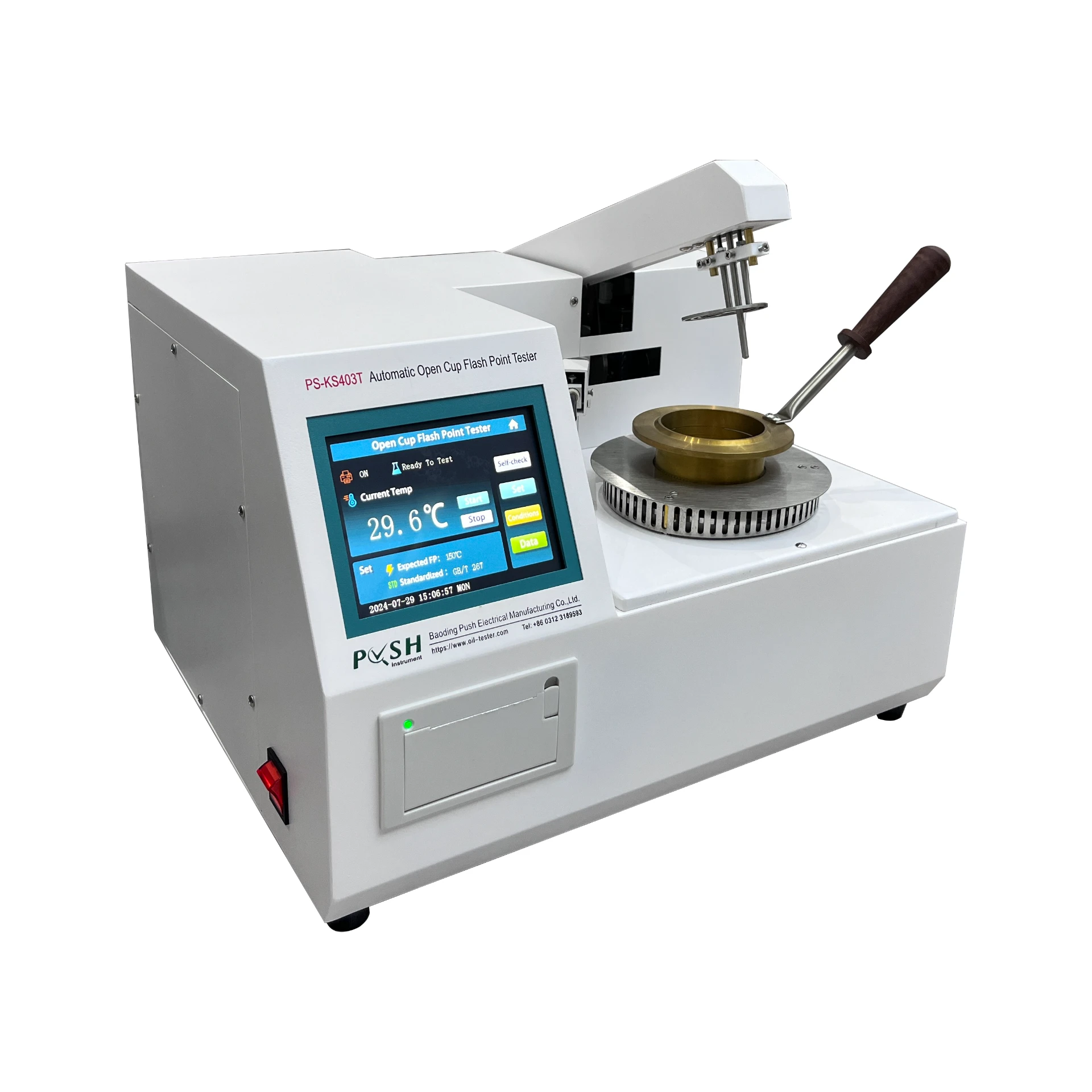
Applications, test data, and customization
Use cases: lube blending release tests, turbine oil acceptance, marine HFO screening, field audits. In one power plant lab, switching to PS-KS403T cut average cycle time by about 15% and reduced retests (operator error) by roughly a third—small win, big morale boost.
- Typical results (illustrative): hydraulic oil flash point ≈ 210 °C; heavy fuel oil ≈ 95 °C.
- Repeatability/reproducibility: ≈ 8–10 °C / 17–20 °C across mid ranges per D92 guidance.
- Certifications: CE; manufactured under ISO 9001; EMC/LVD compliant.
- Customization: multi-language UI, custom heat ramps, barcode, LIMS/API export, accessory kits.
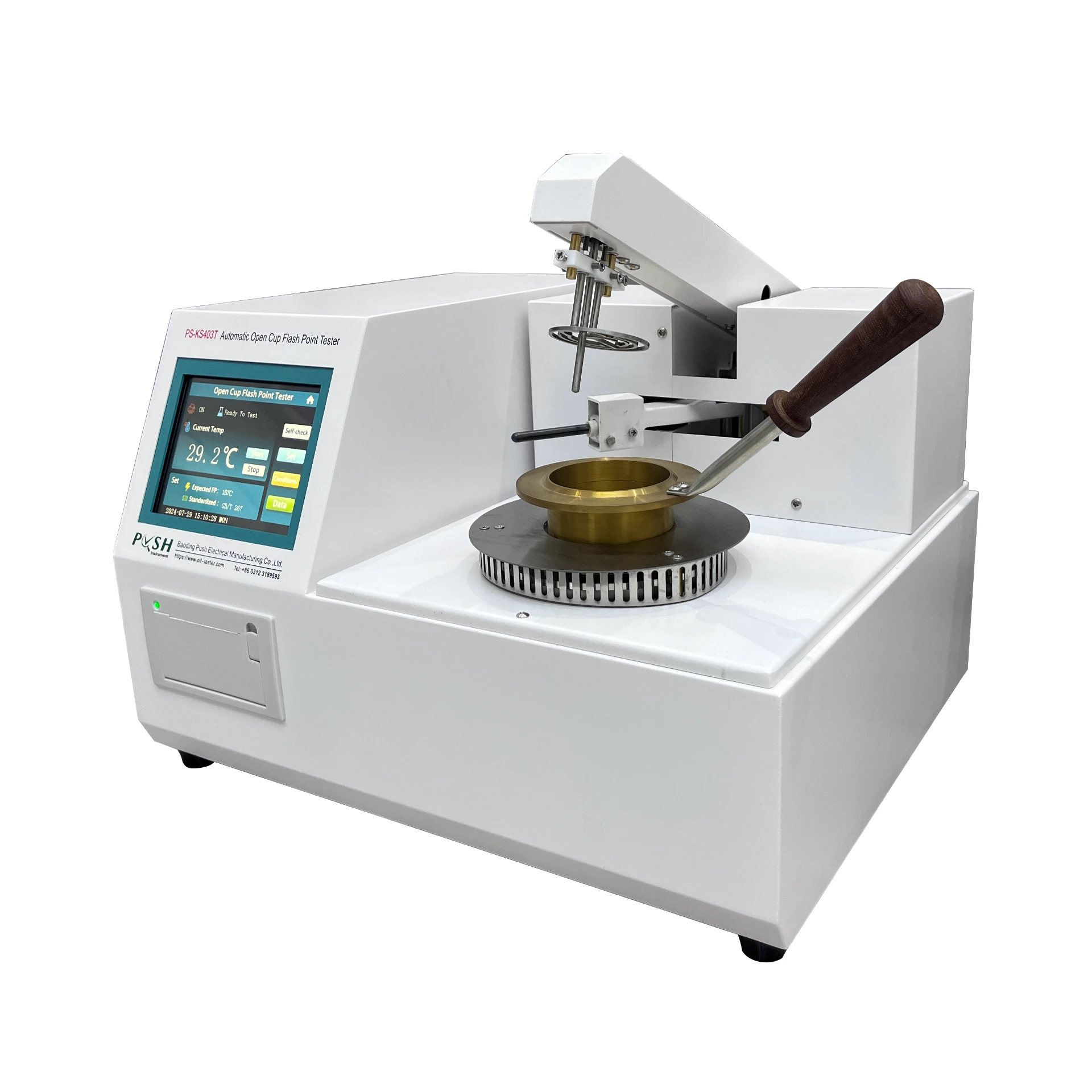
Why this matters for Oil Flash Point programs
Consistency beats heroics. The PS-KS403T’s stable heating profile and durable ignition head mean your Oil Flash Point trendlines stay clean—exactly what auditors and safety managers want to see. And yes, aviation and rail teams care because one low outlier can trigger a cascade of paperwork.
Customer voice
“Setup was quick; our junior techs were productive in a day,” one refinery lab lead told me. Another said the “touch workflow and auto prompts” virtually eliminated misreads. It seems that the small UX touches add up.
Standards and references
-
Find the Best Loop Impedance Tester for Sale and Ensure Electrical SafetyNewsMar.31,2026
-
Comprehensive Guide to Loop Impedance Meter for Electrical SafetyNewsMar.28,2026
-
Understanding and Choosing a Line Impedance Tester for Optimal Network PerformanceNewsMar.26,2026
-
Comprehensive Guide to Line Earth Loop Impedance Test for Electrical SafetyNewsMar.24,2026
-
Comprehensive Guide to Fault Loop Impedance Meter and Electrical SafetyNewsMar.21,2026
-
Comprehensive Guide to External Loop Impedance Test for Electrical SafetyNewsMar.19,2026


